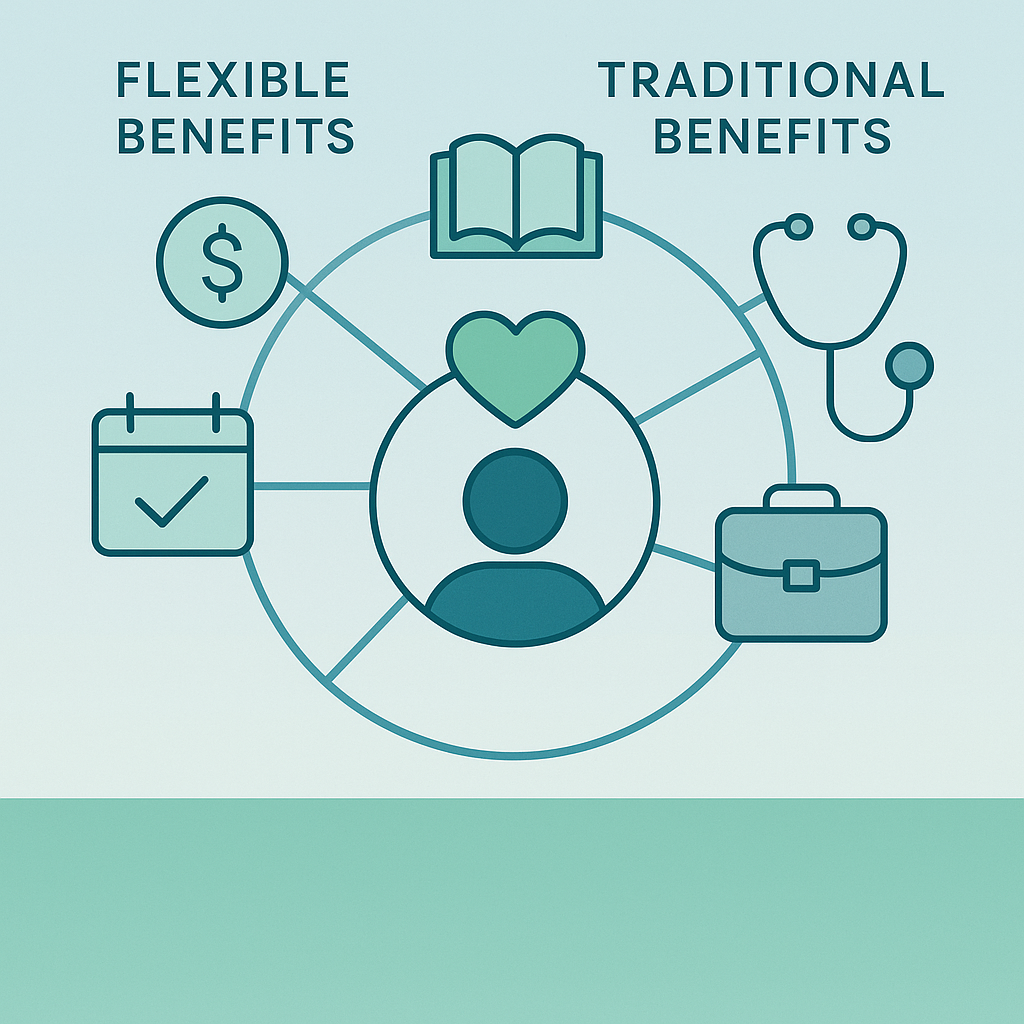
Traditional group insurance plans have served Canadian workplaces for decades, but they were designed for a workforce that looked very different from today's. Employees now span multiple generations, family structures, and health priorities, and a one-size-fits-all benefits package rarely covers everyone well. A flexible benefits plan solves this by letting employees direct their benefit dollars toward the categories that actually matter to them. The result is a compensation model that feels personal, reduces waste, and gives employers meaningful control over costs. What makes these plans particularly effective in Canada is the tax-advantaged framework that supports them, creating genuine financial value on both sides of the employment relationship.
Flexible benefits represent a fundamental shift from prescriptive coverage toward employee-directed spending. Instead of receiving a fixed insurance package with predetermined services and dollar limits, employees receive an allocated amount they can spend across approved benefit categories. This approach acknowledges that a 25-year-old single employee and a 45-year-old parent of three have very different healthcare and wellness needs.
The mechanics behind a flexible benefits program are straightforward once you understand the key components. Employers set an annual or monthly allocation per employee, define which spending categories are eligible, and choose whether to allow rollovers of unused funds. Employees then decide how to distribute their allocation based on personal needs. Most plans are built around two core account types:
Group insurance operates on a pooled-risk model where an insurer sets premiums based on the collective health profile of the workforce. Employees receive a standard package, and unused coverage simply disappears. Flexible benefits flip this model. Employers fund individual accounts with defined contributions, meaning they know exactly what benefits will cost each year. Employees who don't use their full allocation in one category can redirect spending elsewhere, or in many plans, carry unused funds forward as a complement to group insurance. The Canada Revenue Agency outlines the tax treatment of these programs, confirming that HSA reimbursements qualify as non-taxable benefits when properly administered through a trust.
The appeal of customizable employee benefits extends well beyond convenience. For employees, these plans deliver tangible financial value by covering expenses that traditional insurance often ignores. For employers, they provide predictable budgeting, stronger retention signals, and a clear competitive edge in hiring. Understanding the practical advantages helps both sides see why adoption across Canada continues to accelerate.
A younger employee might allocate most of their benefit dollars toward a wellness spending account covering gym memberships, mental health apps, and professional certifications. A working parent might prioritize orthodontic coverage, pediatric services, and prescription drugs through their health spending account. An employee managing a chronic condition could direct their entire allocation toward physiotherapy, chiropractic services, or specialist consultations. The point is that each person's allocation works harder because it targets expenses they actually incur.
This personalization also reduces the frustration employees feel when they pay into a group plan that covers services they never use. With flexible spending in Canada, every dollar has the potential to deliver real value. Employees in Ontario, British Columbia, Alberta, and Quebec all access the same foundational framework for workplace benefits, though provincial health coverage differences can influence which expenses employees prioritize within their flexible plans.
From the employer's perspective, the shift to a flexible benefits program eliminates the unpredictability of annual premium increases that come with traditional group insurance. Instead of negotiating renewal rates with insurers each year, employers set a fixed contribution per employee. This makes budgeting straightforward and removes the risk of cost spikes driven by high-utilization years.
Administration is another area where flexible plans outperform traditional models, especially when managed through an employee benefits platform designed for the task. GoKlaim, for example, allows HR teams to configure benefit categories, set individual or department-level allowances, and track utilization through built-in analytics, all without manual paperwork. Employees submit claims through a mobile app, receive fast reimbursements, and can view their balances in real time. This kind of streamlined experience matters for retention. When employees feel their benefits are easy to use and genuinely relevant, they report higher satisfaction with their overall compensation. For small businesses in Canada that lack the bargaining power to negotiate competitive group insurance rates, platforms like GoKlaim provide a practical way to customize group benefits without the overhead of traditional plans.
Knowing the theory behind flexible benefits is useful, but implementation is where the real questions arise. Employers considering the switch need to understand what expenses are typically eligible, how claims work, and what decisions they need to make before launching a plan. The process is less complicated than most expect, particularly with modern platforms that handle setup and compliance on the employer's behalf.
HSA-eligible expenses are defined by the CRA and include most medical and dental costs not covered by provincial health plans. Dental cleanings, crowns, and orthodontics qualify, as do prescription eyeglasses, contact lenses, laser eye surgery, physiotherapy, massage therapy (when prescribed), hearing aids, and prescription medications. Mental health services, including psychologist and counsellor sessions, are also covered. The key requirement is that the expense must be a qualifying medical expense under the Income Tax Act.
WSA-eligible expenses are defined by the employer, which is where the flexibility really shines. Common categories include fitness memberships, personal training, sports equipment, nutrition coaching, meditation apps, ergonomic office furniture, professional development courses, financial planning services, and even childcare in some configurations. Because WSA expenses are employer-defined rather than CRA-mandated, organizations can tailor categories to reflect their culture and workforce priorities. The distinction between HSA and WSA eligibility is one of the most important things for both employers and employees to understand before launching a plan.
Submitting a claim under a flexible benefits plan typically takes less than five minutes. The employee makes a purchase, photographs the receipt, opens their benefits app or web portal, selects the relevant category, uploads the documentation, and submits. The platform validates the claim against eligible expense rules and the employee's remaining balance, then processes the reimbursement. Most modern platforms, including GoKlaim, handle this cycle within a few business days.
Employees can also add dependents to their accounts, meaning a spouse's dental visit or a child's prescription can be claimed under the same allocation. This is particularly valuable for families where one partner lacks workplace benefits. The transparency of seeing exactly how much remains in each account category empowers employees to make informed spending decisions throughout the year. For employers evaluating where the future of employee benefits is heading, this kind of real-time visibility and control is quickly becoming the expectation rather than the exception.
Flexible benefits plans give employees the ability to direct their benefit dollars toward the health, wellness, and lifestyle expenses that reflect their actual needs. For employers, these plans deliver cost predictability, reduced administrative burden, and a tangible improvement in how employees perceive their compensation. Whether used as a standalone solution or alongside traditional group insurance, a well-structured flexible benefits plan creates a more engaged, supported workforce. The Canadian tax framework makes HSAs and WSAs particularly efficient vehicles for delivering this value. Organizations of any size can implement these plans quickly with the right platform and a clear understanding of their team's priorities.
Ready to offer your team personalized, flexible benefits? Explore GoKlaim to see how easy it is to set up and manage spending accounts for your workforce.
A flexible benefits plan is an employer-funded program that gives employees a set dollar allocation they can spend across approved health, wellness, and lifestyle categories based on their individual needs.
Employees use flexible benefits by submitting receipts for eligible expenses through their benefits platform or app, then receiving reimbursement from their allocated account balance.
HSA-covered expenses include dental, vision, prescription drugs, and mental health services, while WSA-covered expenses can range from gym memberships and fitness equipment to professional development and ergonomic office furniture, depending on employer configuration.
Yes, employers can define which expense categories are available, set different allocation amounts by employee or department, and choose whether unused funds roll over to the next year.
Flexible benefits are available to Canadian businesses of all sizes, and platforms designed for easy administration make them particularly accessible and cost-effective for small and mid-sized employers.