
The modern workplace is defined by its demand for flexibility, a trend that now extends fully to employee benefits. As we move through 2026, Canadian employers are increasingly realizing that outdated, one-size-fits-all benefits packages are failing to meet the diverse needs of their workforce.
The concept of flexible benefits plans in Canada has rapidly evolved from a simple perk into a cornerstone of strategic talent management, essential for attracting and retaining top-tier employees. Unlike traditional plans that offer rigid and limited customization, flexible benefits empower employees to select coverage options that genuinely align with their personal and family circumstances.
This shift gives employers greater control over their spending while significantly boosting employee satisfaction and engagement. The Canadian benefits landscape has undergone a major transformation, with providers now delivering sophisticated digital platforms that merge comprehensive insurance products with intuitive, user-friendly experiences. Whether you are at the helm of a small team or a large enterprise, understanding the available customized employee benefits is no longer optional: it is critical to crafting a competitive and appealing compensation package.
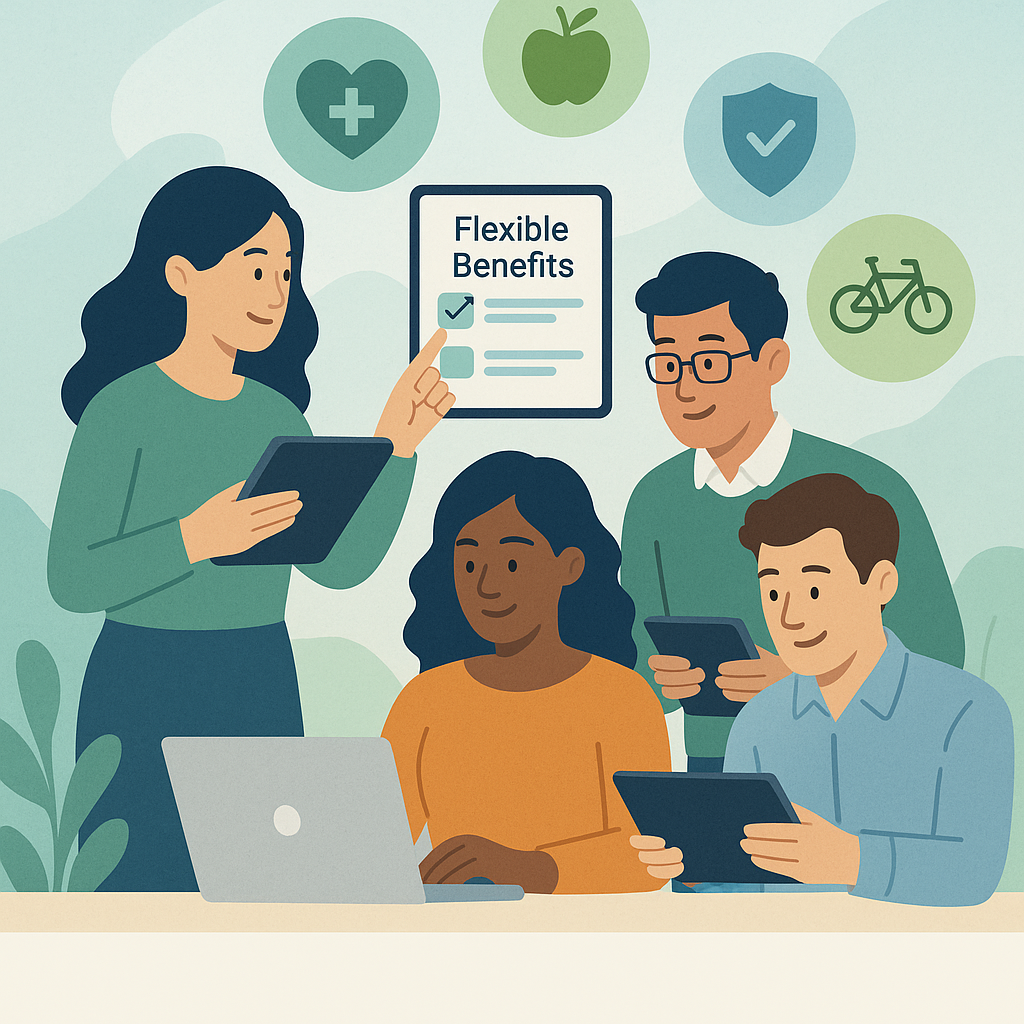
So, what exactly are flexible benefits in Canada, and why should your organization pay attention? At its core, this model represents a fundamental shift in how companies approach employee compensation and well-being. Instead of imposing a standardized package for health, dental, and life insurance on every employee, flexible benefits platforms provide workers with a dedicated benefits budget to allocate as they see fit.
This autonomy is transformative: an employee with young children might direct more funds toward comprehensive dental and extended health care, while a colleague might prioritize critical illness insurance and robust mental health support. This level of personalization reflects a deeper understanding of individual needs.
In Canada, these plans are typically built around core components like Health spending accounts (HSAs) and wellness spending accounts (WSAs), which allow employees to use pre-tax dollars for a wide range of eligible medical and wellness expenses. Layered on top of these accounts are traditional coverage options such as life insurance, dependent coverage, disability insurance, and dental care, along with voluntary benefits like accident insurance.
The regulatory environment adds a layer of complexity, as group benefits are provincially regulated. This means providers must be licensed in every province where a company operates, from Ontario to British Columbia, making careful coordination with licensed carriers a necessity for national employers.
The mechanics of flexible benefits are straightforward, although they can vary slightly between providers. The process begins when an employer establishes a benefits budget for each employee, often calculated as a fixed dollar amount or a percentage of their salary. Employees then access a digital portal, which is typically mobile-friendly and available around the clock, to review the available plans and customize their coverage.
A well-designed platform guides them through their elections, clearly explaining what each option covers and helping them calculate any personal costs. Once employees have made their choices, the provider takes over the administrative heavy lifting. This includes managing enrollment changes, coordinating claims with the underlying insurance carriers, handling payments, and offering real-time visibility into the remaining balances in their spending accounts.
The best platforms fully integrate the claims process into the employee experience, allowing individuals to submit receipts and receive reimbursements without ever needing to visit a separate insurance website. For employers, the administrative burden is drastically reduced. Instead of wrestling with multiple spreadsheets and manual enrollment forms, they get access to a centralized dashboard where they can monitor participation rates, plan selections, and compliance metrics.
Many modern platforms from providers like GoKlaim integrate seamlessly with existing HRIS and payroll systems, automatically synchronizing employee data and ensuring coverage remains accurate without manual intervention.
The rationale for adopting personalized benefits canada is rooted in both employee satisfaction and organizational efficiency. Personalized benefits consistently result in higher engagement than traditional plans because they acknowledge and accommodate the unique circumstances of each employee.
A single parent might allocate more of their budget toward dental and vision coverage, whereas an employee in good health might choose to invest in critical illness insurance as a component of their long-term financial plan. When workers have a real say in their benefits, they are far more likely to use them, and employers reap the rewards through improved health outcomes and higher productivity.
From an organizational standpoint, personalized benefits provide far greater cost control. Instead of overfunding coverage that many employees may not need or use, you allocate a defined budget and empower employees to spend it strategically. This defined contribution approach often leads to better utilization rates and lower overall plan costs.
Furthermore, the data generated by flexible benefits platforms offers unparalleled insight into the needs of your workforce, enabling you to refine your benefits strategy year after year. The impact on employee retention cannot be overstated. In today’s competitive labor market, flexible benefits are increasingly seen as a standard expectation, and organizations that offer them report stronger retention rates, especially among younger demographics who place a high value on choice and personal control.
Selecting a partner starts with clarifying whether your priority is a fully integrated experience, the broadest coverage catalog, or a digital TPA layer that works with your advisor; the summaries below compare approaches so you can match platform capabilities to company size, budget, and administrative capacity.
Alan is a prime example of the new generation of benefits providers, uniquely combining the role of an insurer with an integrated digital platform designed for the modern workplace. Serving teams of fifteen to one hundred employees, Alan positions itself as a streamlined, one-provider solution for companies that value simplicity and a seamless user experience.
The platform processes claims in real-time directly within its app, which eliminates the fragmented and often frustrating experience of traditional insurance models where employees are forced to navigate multiple websites to submit claims and check their balances. What truly sets Alan apart is its fully integrated approach. By operating as both the insurer and the platform provider, Alan delivers faster claims processing, more transparent pricing, and a cohesive user journey from enrollment to reimbursement. For employers, this translates to a significantly lower administrative load compared to legacy insurance systems.
Sun Life and Manulife stand as two of Canada's largest traditional group benefits insurers, with extensive networks that span the entire country. Both companies offer a truly comprehensive suite of traditional group benefits products, including life insurance, dependent coverage, accidental death and dismemberment, dental, extended health care with prescription drug and paramedical coverage, out-of-province medical insurance, both short-term and long-term disability, critical illness insurance, and various spending accounts.
These established giants are particularly well-suited for larger organizations that have complex needs and rely on the support of benefits brokers. Their primary strength lies in the sheer breadth of their product offerings and their deep expertise in managing risk across large and diverse employee populations. However, their digital platforms can sometimes feel dated when compared to the more agile and user-centric interfaces offered by newer entrants in the market.
SimplyBenefits operates as a Third-Party Payor (TPA), delivering a 100% digital administration of employee health benefits through its network of Canadian advisor partners. Instead of acting as an insurance carrier, SimplyBenefits serves as a digital intermediary, processing claims through respected partner insurers like Empire Life and Beneva. The platform is structured with three distinct portals: one for benefits advisors to manage their client relationships, one for employers to administer coverage, and one for employees to access their benefits 24/7 via a desktop or mobile application.
This TPA model provides a cleaner and more modern front-end experience than what is typically offered by traditional insurers, while still retaining the stability and reliability of established carriers handling the claims in the background. SimplyBenefits is an excellent choice for teams that already have a strong relationship with a benefits advisor, as the platform is designed to amplify the advisor's capabilities rather than replace them.
Humi offers a compelling solution by combining HR and payroll functionality with benefits administration, making it a natural fit for startups and growing companies that are already using Humi's core HR platform. Rather than building its own insurance operations, Humi places benefits plans with partner insurers such as Empire Life and Beneva. This gives employees access to high-quality coverage while maintaining a seamless integration with their existing Humi system, eliminating the need for separate logins and manual data synchronization.
The main consideration with Humi's model is that the claims processing experience is dependent on the underlying carrier partner you select, meaning the user experience can vary. This makes Humi particularly well-suited for organizations that place a high priority on HR-to-benefits integration and are comfortable with a bit more administrative involvement than what is required by fully integrated platforms like Alan.
For companies with fewer than fifteen employees, traditional group benefits can often feel financially out of reach due to high administrative overhead and carrier minimums. The Chambers of Commerce Group Insurance Plan directly addresses this challenge through a pooled model, where multiple small employers share risk and administrative costs.
This innovative approach significantly reduces the per-employee cost while still providing access to core coverage options like health, dental, and life insurance. However, the pooled model does involve some trade-offs. While the pricing is predictable, which is great for budgeting, the flexibility is more limited compared to fully customizable platforms. Additionally, claims processing can involve more manual steps, and employers have less control over the specific benefits their employees can access. For micro-businesses where affordability and simplicity are the top priorities, this model offers a very accessible entry point into the world of group benefits.
Is a flexible benefits program a good fit for a small business? The answer is increasingly yes, although the implementation strategy may differ from that of larger corporations. Small businesses grapple with a unique challenge: they need to compete for talent against larger companies that offer robust benefits packages, yet they often lack the employee numbers to make traditional group plans economically viable.
Modern flexible benefits platforms and pooled models have opened up a world of new possibilities. Instead of offering limited and expensive benefits, small employers can now provide customizable packages that rival those of much larger organizations. Platforms like Humi and the Chambers of Commerce Group Insurance Plan are specifically designed with small business constraints in mind, delivering meaningful employee choice and control without breaking the bank.
For businesses with fifteen to fifty employees, platforms such as Alan and SimplyBenefits become highly accessible and effective options. The critical first step is to gain a deep understanding of your employees' priorities, which can be achieved through surveys or focus groups, and then select a platform that accommodates those needs without creating an administrative nightmare.
As we look at the benefits landscape in 2026, several features have become non-negotiable for modern providers in Canada. These are the elements that separate leading platforms from the rest, directly impacting both employee satisfaction and administrative efficiency. Understanding these features is key to selecting a provider that will meet the demands of today's workforce.
Together, these capabilities define the baseline for modern plans in 2026, separating providers that truly enhance employee experience from those offering legacy, transactional portals.
Traditional group benefits and flexible benefits stem from fundamentally different philosophies about how to deliver value. One prioritizes administrative simplicity, while the other champions employee choice. Here’s a breakdown of the core differences:
Ultimately, the philosophy you choose shapes outcomes: standardized plans favor administrative uniformity, while flexible models deliver personalization, measurable engagement gains, and clearer cost governance.
The Canadian employee benefits landscape is undergoing significant shifts as both organizations and providers recognize that personalization is the key to driving better outcomes. An overwhelming majority of Canadian employees prefer flexible benefits, with numerous surveys indicating that 75% or more favor customizable options over standard packages.
This preference cuts across all age groups but is particularly strong among younger workers who expect to have agency in how their employers support their well-being. This trend extends beyond traditional insurance products into emerging categories. Mental health support has transitioned from a peripheral concern to a central component of any competitive benefits package, reflecting both workforce priorities and research showing its direct impact on performance.
Financial wellness tools are also becoming increasingly common as employers acknowledge that financial stress can severely undermine productivity and engagement. Furthermore, wellness spending accounts are evolving to cover a broader range of employee well-being categories, from fitness and nutrition to personal development and emergency financial assistance. This movement towards holistic employee well-being shows a growing realization that traditional healthcare-focused benefits only address one dimension of what people truly need to thrive.
Successfully implementing flexible benefits in Canada starts with thorough assessment and strategic planning. Your first step should be to evaluate your current benefits spending, gain a clear understanding of your employee demographics and their specific needs through surveys or focus groups, and establish clear objectives for what you want the new program to achieve, whether it's cost control, improved retention, or enhanced employee satisfaction.
Next, you must select the provider model that best fits your organization. This decision will fundamentally shape your implementation path: integrated insurers like Alan require a complete transition to their platform but offer the most streamlined experience, while TPA models like SimplyBenefits work alongside your existing advisors, causing less organizational disruption. Once you have a provider, you can work collaboratively on plan design.
This involves defining the total benefits budget per employee, determining which coverage options will be available, and establishing the rules for how spending accounts will function. The most successful implementations involve employee input to ensure the available options align with workforce priorities. Finally, communication is absolutely critical. Employees need clear, accessible explanations of how the new system works and how to make their elections. Plan for an education period of four to six weeks before enrollment to ensure better decision-making and higher satisfaction.
Operating a group benefits plan in Canada requires navigating a complex provincial regulatory framework. Unlike in many other countries, group benefits fall under provincial insurance legislation rather than federal law, meaning your provider must hold valid licenses in each province where your employees reside.
If your organization has teams in Ontario, Quebec, and Alberta, for example, your benefits provider must be officially licensed to operate in all three of those jurisdictions. This structure means that national benefits programs demand careful and continuous coordination with licensed carriers in each relevant province.
This regulatory reality directly influences both provider selection and program flexibility. Large national carriers like Sun Life and Manulife are adept at navigating this landscape through their extensive provincial operations. In contrast, newer platforms may initially focus on specific provinces before expanding their reach, which could affect their accessibility for geographically distributed teams. When you are evaluating potential providers, it is crucial to explicitly confirm that they are licensed in all provinces where you have employees and to understand any potential limitations or variations in their offerings by province.
Developing a coherent benefits strategy Canada for 2026 requires making intentional choices that are tightly aligned with your organization's specific priorities, employee needs, and market position. Begin by clearly articulating what your benefits program should accomplish for your organization.
Are you primarily competing on compensation? Is employee retention your most significant challenge? Or do you need to address specific gaps in employee well-being? Having clear objectives will drive your provider selection and plan design decisions. Second, you must develop a thorough understanding of your employee population. A demographic analysis that looks at age distribution, family status, geographic spread, and industry trends will reveal which benefits are likely to matter most.
A tech company with a younger, healthier workforce might emphasize financial wellness and flexible spending, whereas a more mature organization might prioritize retirement security. Finally, choose a provider model that aligns with your administrative capacity. Integrated platforms require less active management post-implementation, while TPA models delegate insurance complexities to carriers, and traditional insurers with broker support offer expert management. There is no single correct choice, only the right choice for your unique context.
The clear shift toward flexible benefits in Canada reflects much broader changes in how modern organizations attract, retain, and support their employees. The leading providers, including Alan, Sun Life, Manulife, SimplyBenefits, and Humi, each offer distinct approaches that cater to different organizational profiles and priorities.
Small businesses now have access to affordable and flexible options through specialized platforms and pooled models, which eliminates the false choice between offering comprehensive benefits and maintaining a reasonable budget. At the same time, mid-sized and larger organizations can benefit from highly integrated platforms, the scale of established insurers, and sophisticated TPA solutions designed to handle their complexity.
The future of employee benefits Canada is unquestionably flexible and personalized. Employees increasingly expect their benefits to reflect their individual circumstances, and employers now recognize that providing choice is a powerful driver of engagement and retention. As you evaluate your benefits strategy for 2026 and beyond, take the time to consider where your organization and employees stand today, what outcomes matter most, and which provider model will sustainably deliver value for years to come.
Flexible benefits in Canada are customizable employee benefits programs that provide employees with a set budget from their employer to allocate across a variety of coverage options. Instead of a one-size-fits-all package, employees can choose the health, dental, life insurance, disability, and spending account options that best fit their personal needs and circumstances.
Employers allocate a benefits budget to each employee, who then uses a digital platform to select their preferred coverage. This online portal allows them to review options, make selections, and manage their claims and account balances. The chosen provider handles all the back-end administration, including coordinating with insurance carriers and processing reimbursements.
Personalized benefits lead to higher employee satisfaction, better use of benefits, and improved retention. When employees feel their unique situations are understood and catered to, they place a higher value on their benefits package. For employers, this approach also offers better cost control and provides valuable insights into the actual needs of the workforce.
Yes, absolutely. Thanks to modern platforms, pooled plans, and HR-integrated solutions, flexible benefits are now very accessible for small businesses. Providers like Humi and the Chambers of Commerce Group Insurance Plan offer affordable and simplified models that allow small employers to compete with larger companies for top talent.
The most important features are a seamless digital experience with mobile access, real-time claims processing, and integration with HR and payroll systems. Additionally, look for strong offerings in workplace mental health, telehealth, financial wellness tools, and transparent pricing.
The process involves assessing your current spending and employee needs, selecting a provider model that fits your company, designing a plan with employee input, and communicating everything clearly during the enrollment period. A phased rollout with strong educational support is key to a successful transition.
A Health Spending Account (HSA) is an account funded by the employer with pre-tax dollars that employees can use to pay for a wide range of eligible medical expenses not covered by their primary plan. Employees submit receipts for these expenses and are reimbursed from their HSA, making it a tax-effective way to cover out-of-pocket healthcare costs.
Beyond the foundational benefits like extended health, dental, and life insurance, there is a rapidly growing demand for comprehensive mental health coverage, virtual healthcare (telehealth), and financial wellness tools. Wellness Spending Accounts (WSAs) that cover things like gym memberships and personal development are also extremely popular.
Not necessarily. While the technology platform may have a cost, the defined contribution model of flexible benefits can often lead to better cost control and predictability for employers. Many organizations find that they can achieve cost neutrality or even savings compared to their traditional plans, while simultaneously increasing the perceived value of the benefits offered.
Flexible benefits directly impact retention and satisfaction by giving employees a sense of autonomy and acknowledging their diverse needs. When employees can choose benefits that are relevant to their lives, they feel more valued and understood by their employer. This sense of personal recognition is a powerful driver of loyalty and engagement in today's competitive job market.